
Performance confidence & Reading confidence
Published: Mar 3, 2024 | Category: Uncategorized

A Gentle Way to Help Kids (or Adults) Build Performance Confidence?
- by Noa Kageyama, Ph.D.
We tend to think of reading as a calming and relaxing activity. Something we do to wind down before going to sleep at night, or on vacation while sitting poolside with a frosty cold strawberry lemonade.
But for many young children, reading can actually be quite stressful and cause a lot of anxiety.
Because it’s one thing if you’re naturally curious about reading and take to it pretty easily, but a very different story if you struggle at first, feel judged by teachers, or get teased by classmates.
When that’s your experience, confidence can quickly spiral downhill and lead to a destructive cycle, where you avoid reading, fail to improve, get more anxious, make more mistakes, lose even more confidence, and so on.
That sounds like a pretty crummy spiral to get sucked into, of course… But it also sounds much like some of our own experiences with performing a musical instrument can be, no?
Noooo!!!!
I still remember my daughter’s first studio recital, where one of the other students flat-out refused to get on stage, crying and grabbing hold of his mom when it was his turn to play. I don’t know if it was his very first recital, or if he had already had a negative experience with performing, but it was a little heartbreaking to see, and we could all empathize with both child and parent.
Whether we’re that child, or the parent, or teacher, is there anything we can do to help build up a student’s confidence and make performing a more positive experience?
Well, a bunch of programs have been developed over the years to help younger readers gain confidence and reading skills. And there’s one strategy in particular that caught my attention, because it reminded me of something my mom had me do when I was a child. And what might that be?
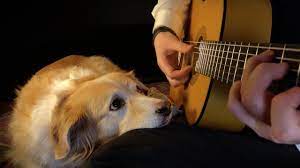
Making reading a positive experience
Well, I’ll describe my mom’s exercise at the end of this article, but the program that intrigued me involves reading out loud to…dogs.
This might sound a little goofy at first, but some studies have found that dogs can have a calming effect that reduce some indicators of stress. And given that they are (at least as far as we can tell) a non-judgmental audience, the idea is that perhaps reading to a dog could be a way to encourage struggling readers to do more reading practice, and help to build their skills and confidence.
Could that really work?
Research on struggling readers
Well, it turns out there is a bit of research in this area! A 2014 South African study (le Roux et al.) looked at 106 third graders who received low scores on a standardized reading test, and were struggling to read at grade level (75% were reading at a Grade 1 level, and 25% were at a Grade 2 level).
Once identified, the students were randomly assigned to one of four groups.
One group served as the control group, and continued with their regular classroom activities.
The students in the other three groups, however, received opportunities to read aloud in different conditions.
One group of students read aloud to a trained adult volunteer (adult group), a second group read aloud to a teddy bear in the presence of a trained adult volunteer (teddy bear group), and a third group read aloud to a trained therapy dog and the owner, who was also trained to facilitate the reading process (dog group).
10 weeks with a reading buddy
For 10 weeks, the students met with their new reading buddy – adult, teddy bear, or dog – for a 20 minute read-aloud session. Mostly, the sessions involved reading books out loud and explaining the difficult words to their live, stuffed, or canine audience.
To see if there would be any changes in reading ability over time, the students’ reading skills were assessed before the program began, after the program concluded, and eight weeks after the end of the program to see if the changes were lasting.
So…was there any difference between the groups?
Speed, accuracy, comprehension
The researchers assessed reading speed, accuracy, and comprehension.
And at the end of the 10-week program, students who read to a therapy dog demonstrated higher reading comprehension scores than students in the other groups. And when assessed again eight weeks later, the dog group continued to score higher in reading comprehension than the other students.
So the results are intriguing, but could this strategy be applied to building confidence among kids who are not so keen on the idea of performing in front of an audience? Well, it’s not apples to apples, of course, but this study did remind me of something my mom often had me do from a very early age…

The “Cinderella” exercise
I grew up a few miles outside of a small midwestern town, in a heavily wooded area, surrounded by birds, squirrels, frogs, and other critters. I also had some chickens and ducks that wandered around the yard and swam in the pond a dozen yards or so from the side of our house.
Like most kids, there were days when I didn’t feel like practicing. So often, my mom would “trick” me into doing a run-through or mock performance by setting up a stand on the porch, and suggesting that I give the animals a performance (you can see me trying to get one of the ducks to stick around a bit, in the photo above).
The challenge she gave me was to see if I could get the animals to respond to my playing. Whether it was one of the ducks, the birds at the bird feeder, or the rogue chicken which broke from the other hens and lived in a grove of trees behind our house (that chicken actually made it into the local newspaper), the goal was to see if I could play beautifully enough to get them to approach me – like that scene in Cinderella where all the animals help her make a dress.
A different mindset
It may sound a little silly, but in hindsight, I think this exercise helped me practice a particular performance mindset, which seems to be in line with what the advocates of reading to dogs describe as being part of the benefit of the exercise.
Whereas anxious readers have some of their cognitive resources tied up by worries about what others might think, and thus cannot engage as deeply in the reading itself, more confident readers seem to be able to immerse themselves more effectively in the book, and read more proficiently.
Aiming for beauty vs. perfection
Likewise, when playing to attract an audience of birds, squirrels, and chickens, my focus was on playing expressively, rather than worrying about playing “perfectly.”
I think somewhere in my 8-year-old brain, I assumed that the key to getting a squirrel to approach, or a bird to sing, or frog to croak lay not in flawless intonation, but in my ability to create a beautiful sound or project some sort of emotion in my playing. Which was a mindset that more naturally transferred over to performances even when my audience was no longer composed of animals, but people.
Takeaways
The idea of doing mock performances for the family pet may sound a little quirky. And it’s a big leap to take the little research on this reading practice strategy and apply it to music performance. But if you have students who aren’t comfortable with the idea of performing in front of an audience, perhaps it could be a helpful exercise to try.
Because this may the rare context in which students can practice performing for a real, but totally non-judgmental audience, and cultivate a mindset that prioritizes playing beautifully, rather than striving to avoid mistakes and worrying about what others might think.
After all, that “don’t screw up” mindset pretty much sucks the fun out of performing, for any performer, at any age, whether it’s in one’s backyard or on stage in front of a packed house. ????